Connect with us

News

More Than Teaching: Suhum and Ayensuano Teachers Shoulder Rising Social Burdens.
Published on June 2 2025

Introduction
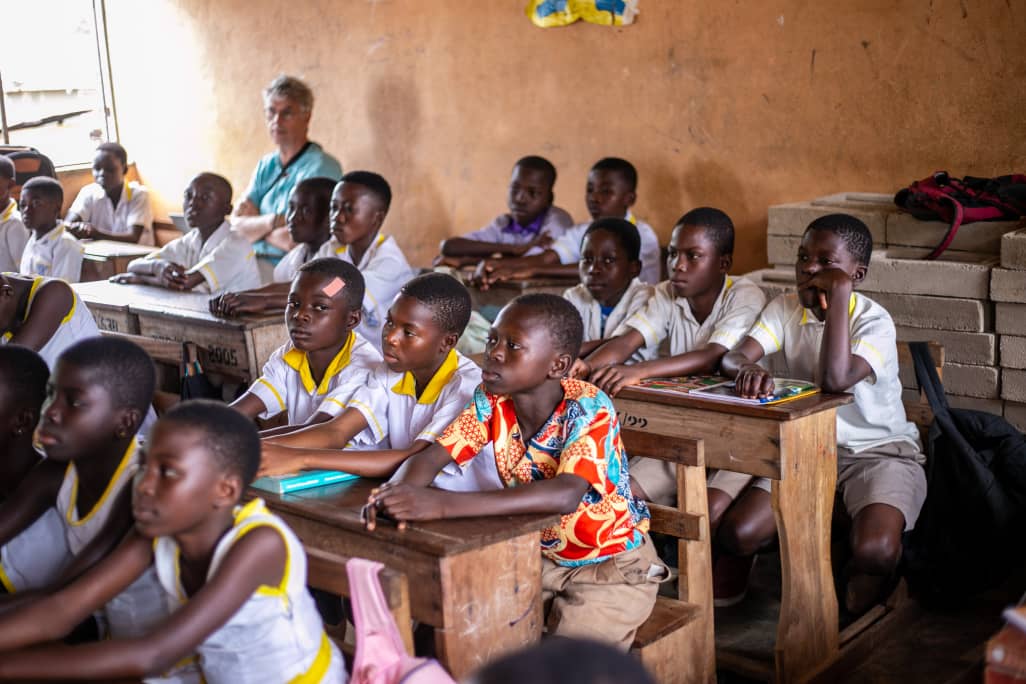
In a modest classroom in Suhum, Madam Abena Yeboah’s day begins not with numbers or textbooks, but with wiping away tears, calming emotional outbursts, and looking out for signs of neglect among her students.
“I trained to teach mathematics,” she says with a quiet sigh. “But now, my mornings are spent comforting hungry children and addressing challenges that go far beyond the classroom syllabus.”

Across Ghana’s Eastern Region, in rural districts like Suhum and Ayensuano, teachers are carrying more than chalk and textbooks. They are increasingly stepping in as caregivers, counselors, and providers. As parental involvement fades, the classroom has become a refuge for children left behind by poverty, migration, and fractured family structures.

Disappearing Parents, Disconnected Homes
For many families, survival has become the top priority. Economic hardship forces parents to focus on feeding their children, often at the expense of their educational involvement. Rural-urban migration has also seen many children left in the care of elderly grandparents or relatives, some of whom are too frail or illiterate to support schoolwork.
“I want to help my children with school,” says Akua Mensima, a single mother in Ayensuano, “but I leave home before sunrise to sell at the market and return after dark. If I don’t work, we don’t eat.”
In communities where both time and resources are stretched thin, the responsibility to raise and mold children is gradually shifting from the family to the teacher.

Burnout in the Classroom
For educators like Mr. Kwame Mensah, the changes are overwhelming.
“It used to be a partnership,” he says. “Parents cared. They came to meetings. Now, we’re expected to handle everything, from feeding hungry students to addressing trauma from unstable homes. And then somehow still teach.”
The pressure is mounting. Teachers are increasingly exhausted and emotionally drained. The demands of Ghana’s new Standard-Based Curriculum, which requires detailed planning and delivery, are often sidelined by the immediate social and emotional needs of their students.
Classroom time is now divided between education and crisis management, leaving learning outcomes hanging in the balance.

A Ray of Hope
Despite the bleak picture, some changes are beginning to take root. Through targeted interventions such as Savana Signatures’ “Rural Youth in Ghana Catching up on Education” project, communities are slowly beginning to re-engage with schools.
The project has conducted 45 community discussions involving over 850 parents and supported the formation of five Child Protection Committees. Since its implementation, teachers in targeted schools report increased parental presence and a notable reduction in classroom stress.
“We didn’t realize how our absence was affecting our children,” one parent confessed after a sensitisation session. “Now, I try to attend meetings and check on their homework. It’s a small start, but it matters.”

Rebuilding the Bridge
Education stakeholders are calling for stronger community-school partnerships. Suggestions include establishing active Parent-Teacher Associations (PTAs), organising family engagement days at schools, creating mentorship programmes for young or single parents and hosting public awareness campaigns to highlight the role of parents in education
“This isn’t about pointing fingers,” says a local education officer. “It’s about bringing parents back into the picture. Teachers can’t raise these children alone.”

Beyond the Curriculum
As the day winds down in Ayensuano, Madam Abena finishes her lesson notes. Today, she has fed a student who hadn’t eaten in two days, comforted another with visible signs of neglect, and settled a dispute between siblings, all before starting her class.
“I love teaching,” she says. “But I can’t keep doing everything. No teacher can.”
Her voice, like that of many others, is not one of anger, but of quiet desperation. Because when the bell rings in Suhum and Ayensuano, it doesn’t just summon children to class, it calls an entire community to action.

By: Prince Kwame Tamakloe/Ralf – Savana Signatures

Continue Reading
Click to comment

Leave a Reply

Your email address will not be published. Required fields are marked *

News

Liverpool appoint Iraola as head coach ‎

Details
Published: June 4 2026
Published at: 7:47Pm
Source BBC Sports

‎Liverpool have appointed Andoni Iraola as their head coach on a two-year contract following the sacking of Arne Slot.

‎The Reds announced Slot’s exit on Saturday, a year after the Dutchman guided them to the Premier League title.

‎Former Bournemouth manager Iraola, 43, joins after delivering the Cherries’ finest top-flight season to date, finishing in sixth place.

‎That was only one position and three points behind Liverpool and gave Bournemouth a place in next season’s Europa League.

‎The Spaniard announced in April that he would leave Bournemouth this summer and he had been linked with Crystal Palace and AC Milan.

‎Now he moves to Merseyside, with Liverpool having qualified for next season’s Champions League despite finishing the Premier League season with 60 points – their lowest tally since 2015-16 and a distant 25 points behind winners Arsenal.

‎”Really excited, really excited,” said Iraola. “Because obviously you know about Liverpool, you know that it’s a big club, a massive club, one of the biggest in the world.

‎”You don’t need a lot of things to get attracted by Liverpool. Liverpool is Liverpool.”

‎He added: “I think Liverpool gives me the chance to coach top players, and top players give you the chance to fight for titles. To win titles.

‎”Obviously when you arrive at a place, you cannot promise everything. You cannot promise. But it’s true that I understand where I’m coming and what is expected.

‎”I’m ready for the challenge.”

‎Iraola is understood to be keen to bring Tommy Elphick and Shaun Cooper, his assistants at Bournemouth, to Anfield as part of his coaching staff.

Continue Reading

News

Black Stars Touch Down in USA for 2026 FIFA World Cup, Ready to Fly Ghana’s Flag High

Details

Published: June 4 2026

Published at: 07: 40am

Story by Saibu Terry

Ghana’s senior national football team, the Black Stars, have officially arrived in the United States ahead of the 2026 FIFA World Cup, marking the start of what many hope will be a memorable campaign on football’s grandest stage.

The four-time African champions touched down on Thursday morning, June 4, 2026, in high spirits, carrying the hopes and expectations of millions of Ghanaians both at home and abroad. Players, technical staff, and officials were warmly received as the team settled into its World Cup base to begin final preparations for the tournament.

The Black Stars’ arrival signals the culmination of months of hard work, meticulous planning, and a successful qualification journey that earned Ghana a place among the world’s football elite. Blending experienced campaigners with a new generation of talented players, the team is determined to compete strongly against the best nations in the world.

Speaking upon arrival, members of the squad expressed confidence in their preparations and reaffirmed their commitment to making the nation proud. They emphasized unity, discipline, and determination as the key values that will guide their quest for success throughout the competition.

Ghana will begin its World Cup campaign against Panama, a fixture that is expected to provide an early test of the Black Stars’ ambitions. The team remains focused and motivated as it looks to make a strong start in the tournament.

Support for the Black Stars has continued to pour in from fans across Ghana and the diaspora, with many expressing optimism about the team’s chances of making a significant impact at the global showpiece.

With national pride at stake and the eyes of the football world watching, the Black Stars are ready to showcase the resilience, talent, and fighting spirit that have long defined Ghanaian football.

As the countdown to their opening match begins, Ghana stands united behind its beloved Black Stars, hoping they can write another glorious chapter in the nation’s rich football history at the 2026 FIFA World Cup.

Continue Reading

News

Haruna Iddrisu Calls for African-Led Digital Education Systems at 18th Ministerial Round Table

Details

Published: June 3 2026

Published at: 8:16Pm

Story by Saibu Terry

Education leaders, policymakers, development partners and technology experts have renewed their commitment to advancing Africa’s digital education agenda following discussions at the 18th Ministerial Round Table focused on building sovereign, innovative and inclusive learning systems across the continent.

Delivering the keynote address, Ghana’s Minister for Education and Member of Parliament for Tamale South, Hon. Haruna Iddrisu, challenged African countries to move beyond dependence on externally developed digital education solutions and position themselves as global leaders in technology-driven learning.

He highlighted Ghana’s ongoing investments in digital education, Science, Technology, Engineering and Mathematics (STEM), artificial intelligence (AI), robotics and curriculum reforms aimed at preparing students for the demands of the future economy.

According to the Minister, Africa’s digital transformation in education must be driven by locally relevant content, stronger institutions and equitable access to technology-enabled learning opportunities. He stressed the importance of ensuring that African learners benefit from educational systems designed to address the continent’s unique needs and realities.

Hon. Iddrisu further called for increased investment in AI literacy and the development of ethical frameworks grounded in African values, cautioning against a situation where the continent becomes merely a consumer of technologies developed elsewhere.

Also speaking at the event, UNESCO Representative to Ghana, Mr. Edmond Moukala, underscored the importance of foundational literacy in an era increasingly shaped by artificial intelligence. He noted that core skills such as reading, writing, critical thinking and information evaluation remain essential building blocks for digital and AI competencies.

Mr. Moukala also advocated the establishment of public digital learning platforms that support teachers, safeguard data privacy and promote education as a public good accessible to all.

The round table concluded with a shared commitment among stakeholders to responsibly harness technology, strengthen partnerships and accelerate Africa’s education priorities through home-grown, inclusive and sustainable digital learning systems.

Participants agreed that collaboration among governments, development partners, educational institutions and technology experts will be crucial to ensuring that Africa’s digital education future is shaped by the continent’s own vision, values and aspirations.

Continue Reading