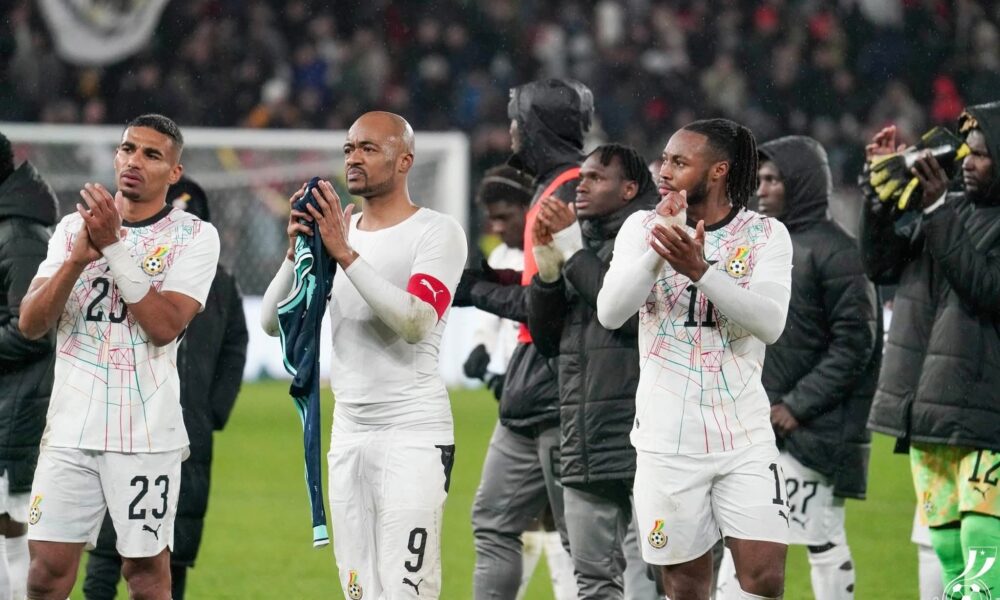
The night of 30th March 2026 will be remembered in Ghana not for celebration, but for the sharp crack of a guillotine. Hours after the Black Stars fell 2-1 to Germany in Stuttgart, their fourth straight friendly defeat, following a humiliating 5-1 thrashing by Austria, the Ghana Football Association dropped the bomb: Otto Addo was out.
No long press conference. No detailed autopsy. Just a terse statement thanking the man who had just guided Ghana to the 2026 World Cup, then wishing him well.
It was the kind of swift, emotional decision that has defined Ghanaian football for decades. Passionate fans demanded blood after those heavy losses. The FA delivered it.
But as the dust settles and the tournament in North America looms just 71 days away, one question hangs heavier than the humid Harmattan air: was this the move that saves the Black Stars… or the one that sinks them?
Let’s be honest, this squad has always been a paradox. From the golden generation of the 2000s to the current crop of Premier League stars, the Black Stars possess the raw materials to trouble any team on their day. They topped their 2026 World Cup qualifying group with authority. Addo became the first coach to qualify Ghana twice. The talent pipeline is still flowing.
Yet the same old ghosts haunt them. Defensive fragility. Tactical rigidity in big moments. A habit of collapsing against organised, high-pressing European sides in pre-tournament friendlies. Missing the 2025 Africa Cup of Nations, the first time in 20 years, was the warning shot.
The recent friendlies were the execution. The team looked disjointed, unsure, almost apologetic on the pitch. For a nation that lives and breathes football, that stings deeper than any scoreline.
The Ghana Football Association finds itself once again in the eye of the storm it helped create. Otto Addo’s record (22 games, 8 wins, 5 draws, 9 losses) was never perfect, but it delivered the one thing that matters most: a ticket to the World Cup.
The timing of his dismissal, right on the cusp of the tournament, raises eyebrows. Was this about results, or about appeasing the loudest voices in the stands and on social media?
Ghanaian football has a well-worn script: poor run of games, public outcry, coach sacked, new saviour hired, repeat. The FA has pulled this lever so often that instability has become the only constant.
Players arrive for camps wondering who will be in charge next month. Technical staff inherit half-baked squads and rushed tactics. And every time, the same administrators who appointed, supported (or failed to support) the coach walk away unscathed.
This is not just about one sacking. It is about a pattern that has turned potential into perpetual “what ifs.”
The 2026 World Cup is no longer a distant dream, it is 11 June away. Ghana still has friendlies lined up against Mexico and Wales in May. A new coach (rumours already swirl around names like Walid Regragui) will have mere weeks to:
(I) Drill defensive organisation that has leaked like a sieve.
(II) Forge chemistry among a squad of global stars who rarely play together.
(III) Finalize a 26-man roster under immense pressure.
(IV) Inject belief into a team that has just been told its leader wasn’t good enough.
This is not preparation. This is crisis management wearing a national jersey.
Sacking Addo is done. Regret changes nothing. The only question that matters is what comes next. Here is the roadmap Ghana must follow if the Black Stars are to write a new chapter instead of another tragic verse:
1. Appoint with urgency and vision, not panic. The next coach cannot be a short-term firefighter. He must be a proven tournament performer who can hit the ground running. Give him real authority over squad selection and tactics. No more committee interference.
2. Turn the remaining friendlies into laboratories. Use Mexico and Wales matches to test systems, not to chase results. Experiment boldly. Build the starting XI that will face the group stage in June.
3. Demand FA accountability – publicly and structurally. Fans and media must keep the heat on the administrators. Why were defensive weaknesses allowed to fester? Why were preparation camps and logistics not world-class? The FA should release a transparent post-mortem and commit to long-term reforms: youth academy overhaul, domestic league investment, and player welfare protocols that actually work.
4. Unite the family. Bring back senior players as leaders. Create a technical advisory panel that includes past legends. Ghanaian football thrives when it feels like a national mission, not a boardroom power play.
5. Embrace the pressure. The Black Stars have always performed when the world doubts them. This is not the time for fear; it is the time for the famous Ghanaian never-say-die spirit that once made the world stand up and take notice.
The sacking of Otto Addo was understandable in the heat of the moment. Whether it was wise will be judged not by headlines today, but by how Ghana performs when the World Cup whistle blows in June.
The talent is there. The passion has never left. The only missing piece is stability, strategy, and the courage to break the cycle.
The nation, and the entire Black Stars family are watching. The clock is ticking. This is not just another coaching change, it is a moment of truth for Ghanaian football.
Will the Black Stars rise, or will history repeat itself? The answer starts now.